Origin
The Mishnah describes what is set before the leader of the seder, and records Rabban Gamliel's saying that whoever has not mentioned three things – the Passover offering, matzah and maror – has not fulfilled the obligation.1,2
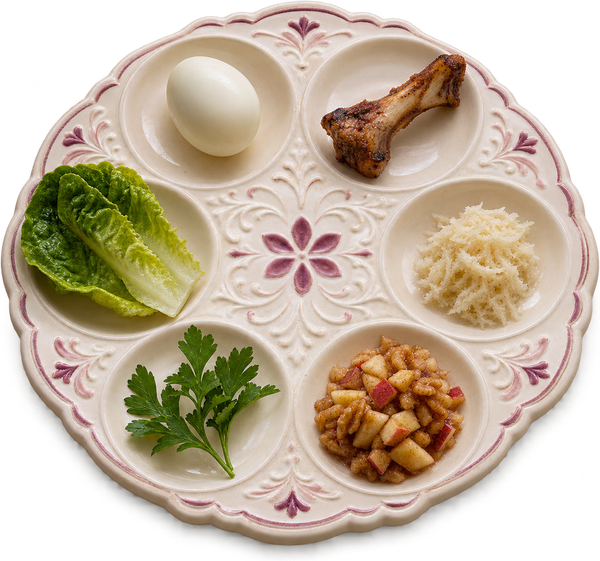
According to the Talmud, the two cooked foods (the bone and the egg) recall the Passover offering and the festival offering.3
Meaning
The zeroa (bone) recalls the Passover offering; the beitzah (egg) the festival offering, the chagigah, and mourning for the Temple; maror and chazeret the bitterness of slavery; Charoset the mortar from which the slaves made bricks; karpas spring, and tears when it is dipped in salt water.4
Use
The arrangement of the foods varies: the layout according to the Ari (Isaac Luria) is widespread, while other communities follow the Rema or the Vilna Gaon. Three matzot lie beside the plate or beneath it.5
Historical development
Special seder plates spread from the early modern period; they were made of pewter, ceramic or silver, often with Hebrew inscriptions and scenes from the Haggadah. The collection of the Jewish Museum in Prague includes pewter plates from the Czech lands.6
Related traditions
In some Sephardi and Mizrahi communities, at the beginning of the seder the plate or basket with the seder foods is lifted and circled above the heads of those present.
In some modern, mainly liberal households new symbols are added (e.g. an orange); these are recent customs without halakhic standing.
FAQ
Is the bone from the seder plate eaten?
No, the zeroa is not eaten; it is only a reminder of the offering.
Why are there two bitter herbs on the plate?
The maror is used for the blessing and eating itself, the chazeret for the korekh (Hillel's sandwich). Some communities do not use the second herb.
Does the plate have to be a special one?
No. Any plate will do; special plates are a custom and an adornment.
Sources
Primary sources
- 1Mishnah Pesachim, 10:3 text ↗
- 2Mishnah Pesachim, 10:5 text ↗
- 3Babylonian Talmud, Pesachim, 114b text ↗
- 4Passover Haggadah
- 5Shulchan Arukh, Orach Chayim, 473:4 – glosa Rema text ↗
- 7Mishnah Pesachim, 10 text ↗
- 8Shulchan Arukh, Orach Chayim, 473 text ↗