מקור
משמעות
שימוש
There are three kinds of sound: tekiah (long), shevarim (three broken) and teruah (rapid short blasts); their combination stems from Talmudic uncertainty about the form of the teruah.8,9
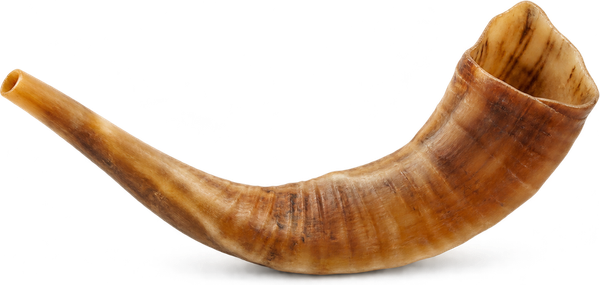
The horn of any kosher animal is valid except that of a cow; a curved ram's horn is preferred.10,11
The shofar is not sounded when Rosh Hashanah falls on Shabbat.12
התפתחות היסטורית
In biblical times the shofar was a signaling instrument in battle and at coronations; the story of the fall of Jericho is well known.13
מסורות קשורות
In Ashkenazi practice the shofar is sounded after morning prayer throughout the month of Elul; Sephardim recite selichot during Elul.14
Yemenite Jews use a long, twisted shofar made from the horn of a kudu antelope.
Yom Kippur ends with a single long blast of the shofar.
שאלות נפוצות
Why a ram's horn?
It recalls the ram that was offered in place of Isaac.
Why is the shofar not sounded on Shabbat?
The Mishnah restricted it to the Temple; the Talmud cites the concern that someone might carry the shofar through a public domain.
Can a cow's horn be used?
No. It would recall the sin of the golden calf.
מקורות
מקורות ראשוניים
- 1Leviticus, 23:24 text ↗
- 2Numbers, 29:1 text ↗
- 3Exodus, 19:16–19 text ↗
- 4Leviticus, 25:9 text ↗
- 5Babylonian Talmud, Rosh Hashanah, 16a text ↗
- 6Genesis, 22:13 text ↗
- 7Mishneh Torah, Hilchot tšuva 3:4
- 8Mishnah Rosh Hashanah, 4:9 text ↗
- 9Babylonian Talmud, Rosh Hashanah, 34a text ↗
- 10Mishnah Rosh Hashanah, 3:2 text ↗
- 11Shulchan Arukh, Orach Chayim, 586:1 text ↗
- 12Mishnah Rosh Hashanah, 4:1 text ↗
- 13Joshua, 6:4–20 text ↗
- 14Shulchan Arukh, Orach Chayim, 581:1 – glosa Rema text ↗
- 15Babylonian Talmud, Rosh Hashanah, 29b text ↗
- 16Mishnah Rosh Hashanah, 3–4 text ↗
- 17Babylonian Talmud, Rosh Hashanah, 16a, 33b–34a text ↗
- 18Shulchan Arukh, Orach Chayim, 585–596 text ↗